


We Need to Talk About Kevin book ending: Shriver saves one reveal for the final pages that the film had no way to hide
Lionel Shriver's novel spends four hundred pages as a wife's correspondence with her husband, and the final chapter changes what you've been reading. Here's how the book's structure hides something a camera can't.
Eva Khatchadourian writes to Franklin for the length of an entire novel, working through their marriage, their son and the Thursday that ended both. The last letters do something to all the ones before them.
Shriver's 2003 novel is epistolary, and that isn't a stylistic flourish — it's the delivery mechanism. Every chapter is a letter from Eva to her estranged husband, dated across 2000 and 2001, reconstructing Kevin from conception through to the massacre he committed at fifteen with a crossbow, three days before his sixteenth birthday. She writes about Franklin in the present tense. She complains about him. She asks him things. She assumes he's reading.
What the letters are covering for
Eva's account of the massacre itself is detailed and early: Kevin used bicycle locks to seal nine people into the school gymnasium — seven students, a cafeteria worker and a teacher — and killed them with a crossbow he'd been given as a gift and had practiced with for years. That is not the withheld information. The book gives it up without much ceremony, because the withheld information is somewhere else entirely.

Eva also circles, repeatedly, around Celia — the second child, the one who wasn't Kevin, the one who lost an eye to drain cleaner in an accident Eva never believed was an accident. Celia is discussed in the past tense in a way Eva keeps not explaining.
The letters are the alibi. A novel addressed to someone has already made a claim about that person, and it makes it on every single page.
The last chapter
Before Kevin went to school that Thursday, he killed Franklin and Celia at home with the same crossbow. Shriver holds this to the final pages. Every earlier letter — the recriminations, the shared memories, the appeals to a man who never answers — has been addressed to a dead husband about a dead daughter, and Eva has been writing them anyway.
The novel's actual close is quieter. Two years on, Eva visits Kevin in prison shortly before his transfer out of juvenile detention, and asks him directly why he did it.
"I used to think I knew. Now I'm not so sure," Kevin tells her, and it is the closest thing to an answer the book supplies.
She embraces him. She goes home and makes up a room for him to come back to. Whatever the reader has concluded about her culpability, Eva ends the book choosing him.
Why Lynne Ramsay couldn't do it that way
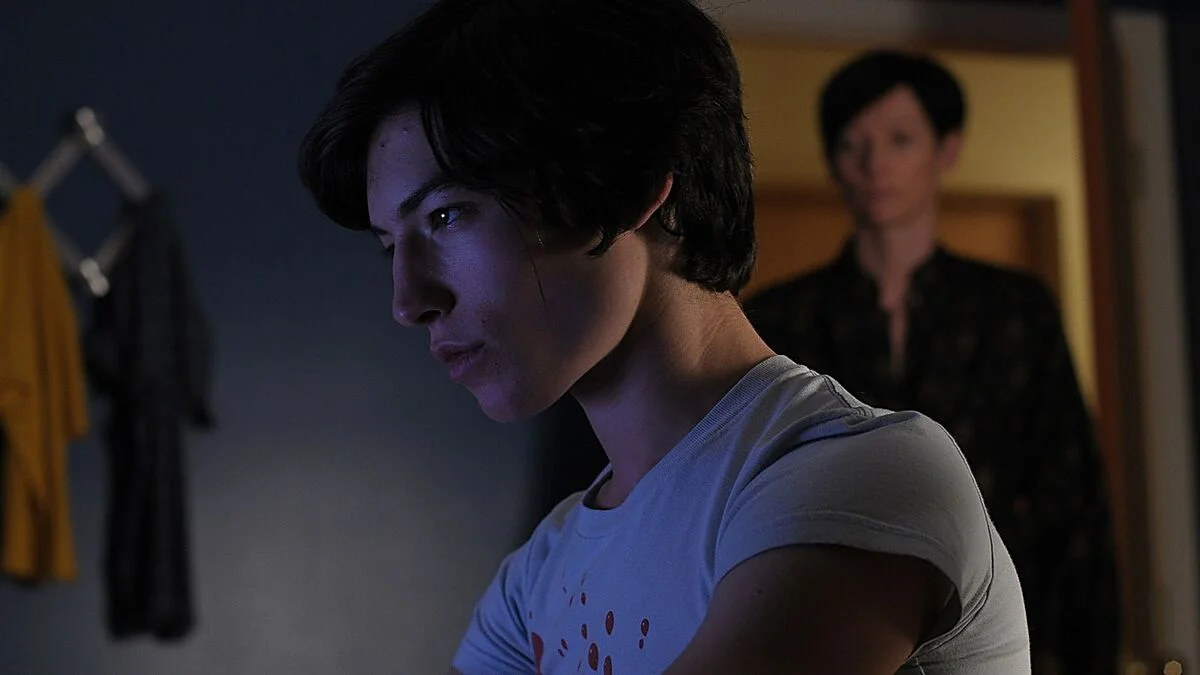
The 2011 adaptation, with Tilda Swinton as Eva, John C. Reilly as Franklin and Ezra Miller as Kevin, is not narrated in letters — it's shot as fractured memory, red-saturated and largely wordless, moving between the present-day Eva and everything that produced her. That structure withholds plenty. What it cannot do is pretend Franklin is alive, because a film has no addressee. There's nobody for the images to be lying to.
Ramsay's solution is to withhold the bodies rather than the fact. The film keeps the backyard and the archery target in the frame repeatedly, shows the aftermath late, and lets the audience assemble the timeline from images rather than from a confession.
- The novel — hides the deaths inside the form; the reader is the one being deceived, in real time, by Eva's grammar.
- The film — hides the deaths inside the edit; the audience is kept from a sight, not from a fact.
- Both — end on Eva and Kevin in the same room, with the same non-answer.
For the record: We Need to Talk About Kevin was published in April 2003, won the Orange Prize in 2005 after being turned down by roughly thirty publishers, and in 2010 was voted by Waterstones readers the best Orange Prize winner of the award's first fifteen years.
Read more: If I Had Legs I'd Kick You true story: Mary Bronstein wrote it while her daughter was in treatment