


Jeanne du Barry: what happened to Zamor between the gift box and the guillotine
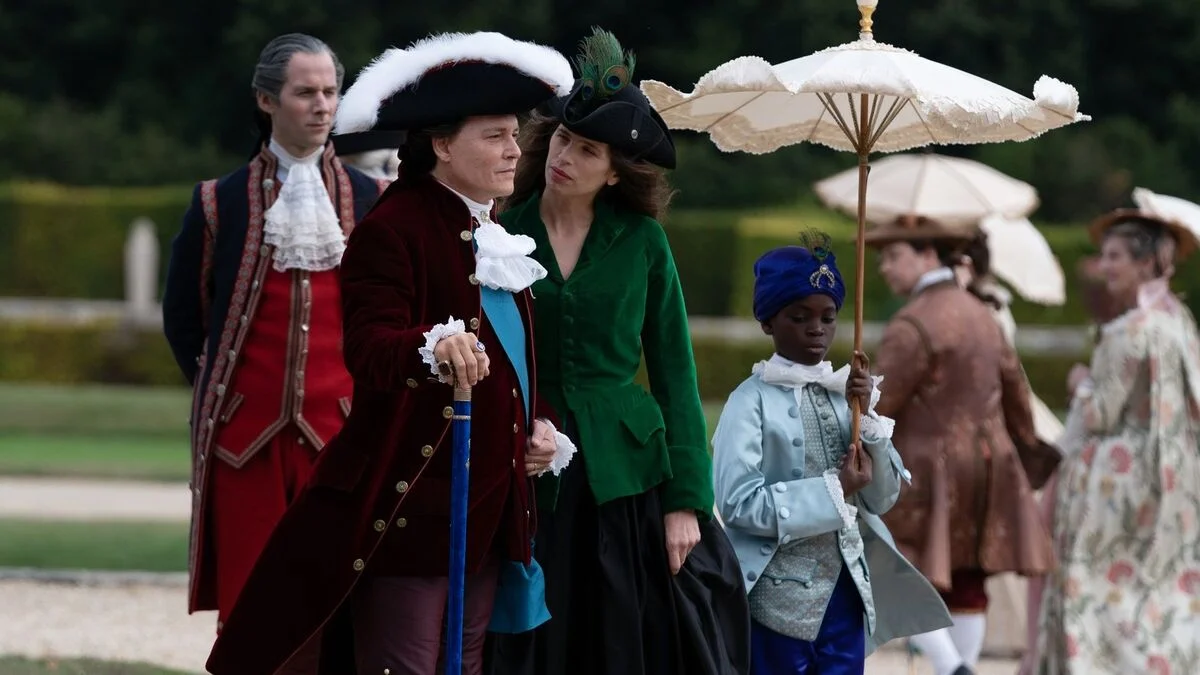
Maïwenn's film hands Jeanne du Barry a Bengali page as a present and closes his story in one line of narration. The documented life of Louis-Benoît Zamor takes up rather more room than that.
He arrives at Versailles as a present and exits the film as a sentence of voiceover. What sits between those two moments is a thirty-year life the movie shows almost none of.
In Jeanne du Barry (2023), Zamor is played by two actors — Ibrahim Yaffa as a child, Djibril Djimo as a teenager — and is introduced exactly as the historical record has it: given to Jeanne by Louis XV as a page. Maïwenn stages the relationship as affectionate and childlike. The film's closing narration then reports that he denounced her during the Revolution, and does it "out of distress or spite."
What the film leaves in the gap
Almost everything. The picture covers roughly 1743 to 1774, ends with Jeanne's expulsion from Versailles after Louis XV's death from smallpox, and compresses the following nineteen years — the Revolution, the denunciation, the execution on 8 December 1793 — into narration. Zamor gets no scenes as an adult.

Reviewers noticed. Roger Ebert's site called the portrayal "simplistic, not to mention dishonest" in 2024, and took particular issue with that closing line.
"This sounds suspiciously like 'he bit the hand that fed him,'" the RogerEbert.com review argued, proposing "out of justifiable anger" as the more accurate reading.
The academic journal H-France Imaginaries was harsher in its Spring 2024 assessment, and on the same point.
"Her cringe-worthy treatment of him as a pet rings true, although the film also tries to suggest that du Barry was a kind person," the authors wrote, concluding that "in her effort to create a modern Jeanne du Barry, Maïwenn has created a film for nineteenth-century historians."
Who he actually was
Louis-Benoît Zamor was born around 1762 in Chittagong, Bengal, possibly of Siddi descent, and sold into the Indian Ocean slave trade for which Chittagong served as a depot. He reached France by an unknown route — likely via a British sea captain — and was bought for Louis XV by either the Prince de Conti or the Duc de Richelieu. The king passed him to du Barry, who had him baptized at Notre-Dame, Versailles, gave him the name, and paid for his education. He lived at Versailles and, from 1776, at Louveciennes.
Read more: If I Had Legs I'd Kick You true story: Mary Bronstein wrote it while her daughter was in treatment
He was about 27 when the Revolution started. He joined the Jacobins and worked for the Committee of Public Safety.
The Englishman the film doesn't mention
The denunciation was not improvised. George Grieve, an English radical who signed himself "ami de Franklin et de Marat," ran it:
- Winter 1792 — Grieve takes lodgings at Louveciennes while du Barry is in London, and wins over two of her servants. Zamor is the one whose information is later used at her trial.
- March 1793 — he draws up a list of suspected counter-revolutionaries with her name at the top.
- 1 July 1793 — he escorts the municipality to the bar of the Convention and obtains authority to arrest her.
- 31 July 1793 — he publishes the pamphlet L'égalité controuvée, ou petite histoire… de la Du Barry.
- 19 November 1793 — after her final arrest, he supervises the search for her jewels, hidden in dungheaps, and testifies at the trial.
Zamor's own contribution came in two stages. He supplied information leading to her arrest in 1792; when she found out and dismissed him, he brought further charges. She went to the guillotine on 8 December 1793.
After
The Girondins arrested him and released him six weeks later for insufficient evidence. He then vanishes from the record between 1794 and 1815, and resurfaces as a schoolteacher in the 5th arrondissement, near the Latin Quarter, reportedly unpopular for his severity. He died on 7 February 1820. Nobody came to the funeral.
For the record: Jeanne du Barry opened the Cannes Film Festival on 16 May 2023 to a seven-minute standing ovation, cost $22.4 million, took $14.9 million worldwide, and sits at 48% on Rotten Tomatoes and 48 on Metacritic.